BF-MATH-NORMALIZERS - Normalizers
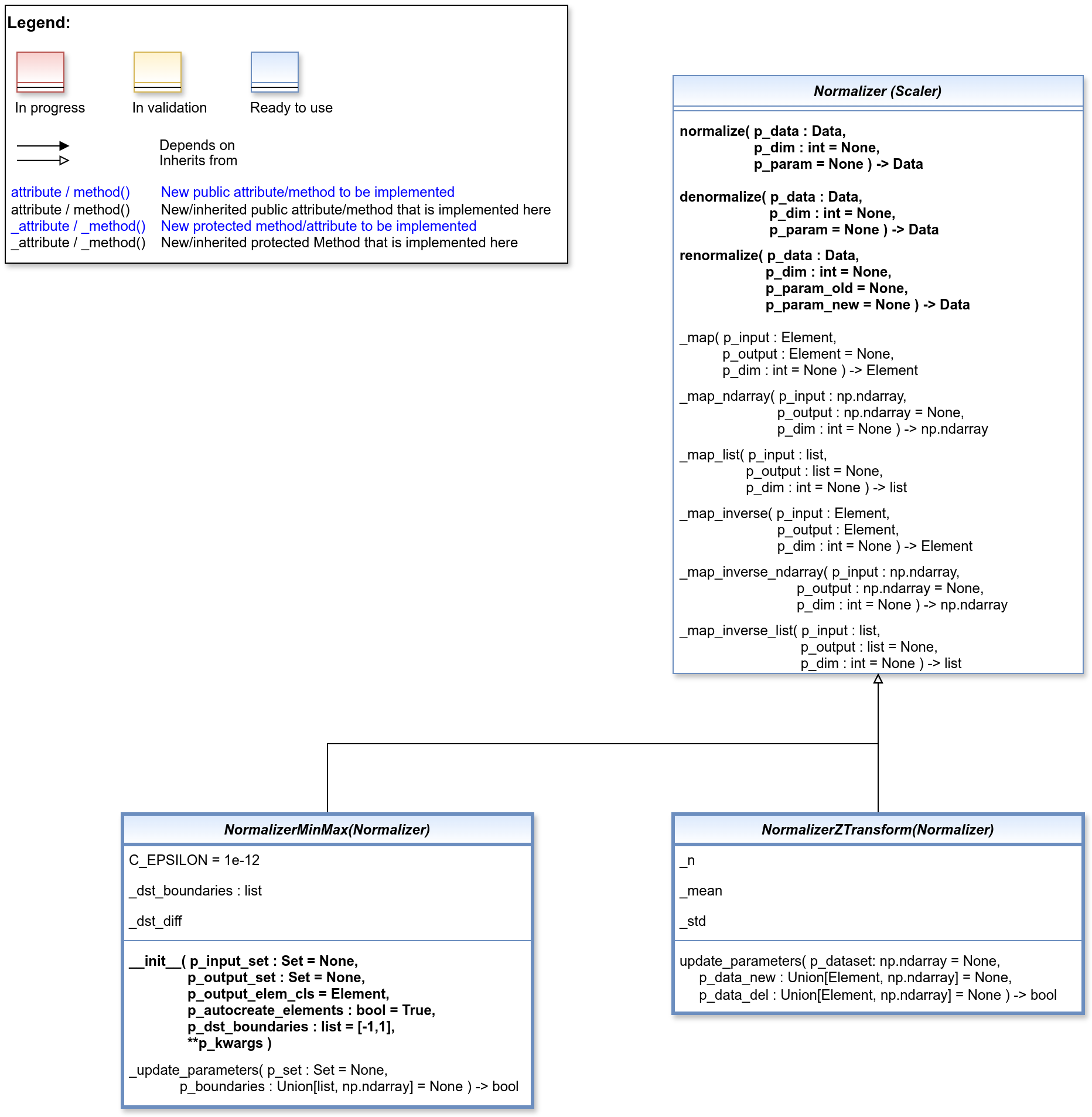
Ver. 2.0.1 (2025-07-07)
This module provides base class for Normalizers and normalizer objects including MinMax normalization and normalization by Z transformation.
- class mlpro.bf.math.normalizers.basics.Normalizer(p_input_set: ~mlpro.bf.math.basics.Set = None, p_output_set: ~mlpro.bf.math.basics.Set = None, p_input_space=None, p_output_space=None, p_output_elem_cls: type = <class 'mlpro.bf.math.basics.Element'>, p_autocreate_elements: bool = True, **p_kwargs)
Bases:
ScalerBase class for normalizers. A normalizer in MLPro is a linear scaler with a fixed parameter structure providing the following basic operations:
Normalization (= scaling): scaled_data = unscaled_data * self._param[0] + self._param[1] Denormalization (= unscaling): unscaled_data = ( scaled_data - self._param[1] ) / self._param[0] Renormalization (= unscaling with old params and scaling with new params)
self._param_old and self._param_new are Numpy arrays of shape (2, n_dims) where n_dims is the number of dimensions of the data to be normalized. The first row contains the scaling factors and the second row contains the offsets for each dimension.
- Parameters:
details. (See class Scaler for)
- normalize(p_data: float | list | ndarray | Element, p_dim: int = None, p_param=None) float | list | ndarray | Element
Normalizes the specified data.
- Parameters:
p_data (Data) – Data to be normalized.
p_dim (int = None) – Optional index of the dimension to be normalized.
None (p_param =) – Optional parameter set to be applied to the normalization. If None the set stored in self._param_new is used.
- Returns:
The normalized data.
- Return type:
Data
- denormalize(p_data: float | list | ndarray | Element, p_dim: int = None, p_param=None) float | list | ndarray | Element
Denormalizes the specified data.
- Parameters:
p_data (Data) – Data to be denormalized.
p_dim (int = None) – Optional index of the dimension to be denormalized.
None (p_param =) – Optional parameter set to be applied to the denormalization. If None the set stored in self._param_old is used.
- Returns:
The normalized data.
- Return type:
Data
- renormalize(p_data: float | list | ndarray | Element, p_dim: int = None, p_param_old=None, p_param_new=None) float | list | ndarray | Element
Renormalizes the specified data by denormalizing them with previous parameters stored in _param_old and normalize them with the current parameters in _param_new.
- Parameters:
p_data (Data) – Data to be renormalized.
p_dim (int = None) – Optional index of the dimension to be renormalized.
None (p_param_new =) – Optional parameter set to be applied to the denormalization. If None the set stored in self._param_old is used.
None – Optional parameter set to be applied to the normalizaion. If None the set stored in self._param_new is used.
- Returns:
The renormalized data.
- Return type:
Data
- _map(p_input: Element, p_output: Element = None, p_dim: int = None) Element
Default custom method for own mappings of single objects of type Element.
- _map_ndarray(p_input: ndarray, p_output: ndarray = None, p_dim=None) ndarray
Custom method for own mass mappings of Numpy arrays.
- Parameters:
p_input (list) – Input to be mapped.
p_output (list = None) – Optional output object as the intended receiver of the mapping result.
p_dim (int = None) – An optional dimension index to which the mapping is restricted.
- Returns:
Result of the mapping.
- Return type:
np.ndarray
- _map_list(p_input: list, p_output: list = None, p_dim=None) list
Custom method for own mass mappings of lists.
- Parameters:
p_input (list) – Input to be mapped.
p_output (list = None) – Optional output object as the intended receiver of the mapping result.
p_dim (int = None) – An optional dimension index to which the mapping is restricted.
- Returns:
Result of the mapping.
- Return type:
list
- _map_inverse(p_input: Element, p_output: Element = None, p_dim: int = None) Element
Default custom method for own inverse mappings of single objects of type Element.
- _map_inverse_ndarray(p_input: ndarray, p_output: ndarray = None, p_dim=None) ndarray
Custom method for own mass inverse mappings of Numpy arrays.
- Parameters:
p_input (list) – Input to be mapped.
p_output (list = None) – Optional output object as the intended receiver of the mapping result.
p_dim (int = None) – An optional dimension index to which the mapping is restricted.
- Returns:
Result of the mapping.
- Return type:
np.ndarray
- _map_inverse_list(p_input: list, p_output: list = None, p_dim=None) list
Custom method for own mass inverse mappings of lists.
- Parameters:
p_input (list) – Input to be mapped.
p_output (list = None) – Optional output object as the intended receiver of the mapping result.
p_dim (int = None) – An optional dimension index to which the mapping is restricted.
- Returns:
Result of the mapping.
- Return type:
list
- class mlpro.bf.math.normalizers.basics.Renormalizable
Bases:
objectProperty class to add custom renomalization of internally stored data.
- renormalize(p_normalizer: Normalizer)
Custom method to renormalize internally stored data.
- Parameters:
p_normalizer (Normalizier) – Suitable normalizer object to be used for renormalization.
Ver. 2.2.0 (2025-06-30)
This module provides a class for MinMax normalization.
- class mlpro.bf.math.normalizers.minmax.NormalizerMinMax(p_input_set: ~mlpro.bf.math.basics.Set = None, p_output_set: ~mlpro.bf.math.basics.Set = None, p_output_elem_cls: type = <class 'mlpro.bf.math.basics.Element'>, p_autocreate_elements: bool = True, p_dst_boundaries: list = [-1, 1], **p_kwargs)
Bases:
NormalizerClass to normalize elements based on MinMax normalization.
- Parameters:
p_input_set (Set = None) – Optional input set, needed for the mapping of objects of type Element.
p_output_set (Set = None) – Optional output set, needed for the mapping of objects of type Element.
p_output_elem_cls (type = Element) – Output element class (compatible to class Element)
p_autocreate_elements (bool = True) – If True, elements of the output space are created automatically during mapping of objects of type Element.
p_dst_boundaries (list = [-1,1]) – Explicit list of (low, high) destination boundaries. Default is [-1, 1].
- C_EPSILON = 1e-12
- _update_parameters(p_set: Set = None, p_boundaries: list | ndarray = None) bool
Update the normalization parameters using MinMax strategy.
- Parameters:
p_set (Set, optional) – A set object providing dimensional boundaries per feature.
p_boundaries (list or np.ndarray, optional) – Explicit array of (low, high) boundaries for each dimension.
- Raises:
ParamError – Raised if neither p_set nor p_boundaries is provided.
Ver. 2.0.0 (2025-07-05)
This module provides a class for Z transformation.
- class mlpro.bf.math.normalizers.ztrans.NormalizerZTrans(p_input_set: ~mlpro.bf.math.basics.Set = None, p_output_set: ~mlpro.bf.math.basics.Set = None, p_output_elem_cls: type = <class 'mlpro.bf.math.basics.Element'>, p_autocreate_elements: bool = True, **p_kwargs)
Bases:
NormalizerClass for Normalization based on Z transformation.
- C_SCIREF_TYPE = 'Online'
- C_SCIREF_URL = 'http://datagenetics.com/blog/november22017/index.html'
- C_SCIREF_ACCESSED = '2024-05-27'
- C_EPSILON = 1e-08