BF-MATH - Basic Mathematics
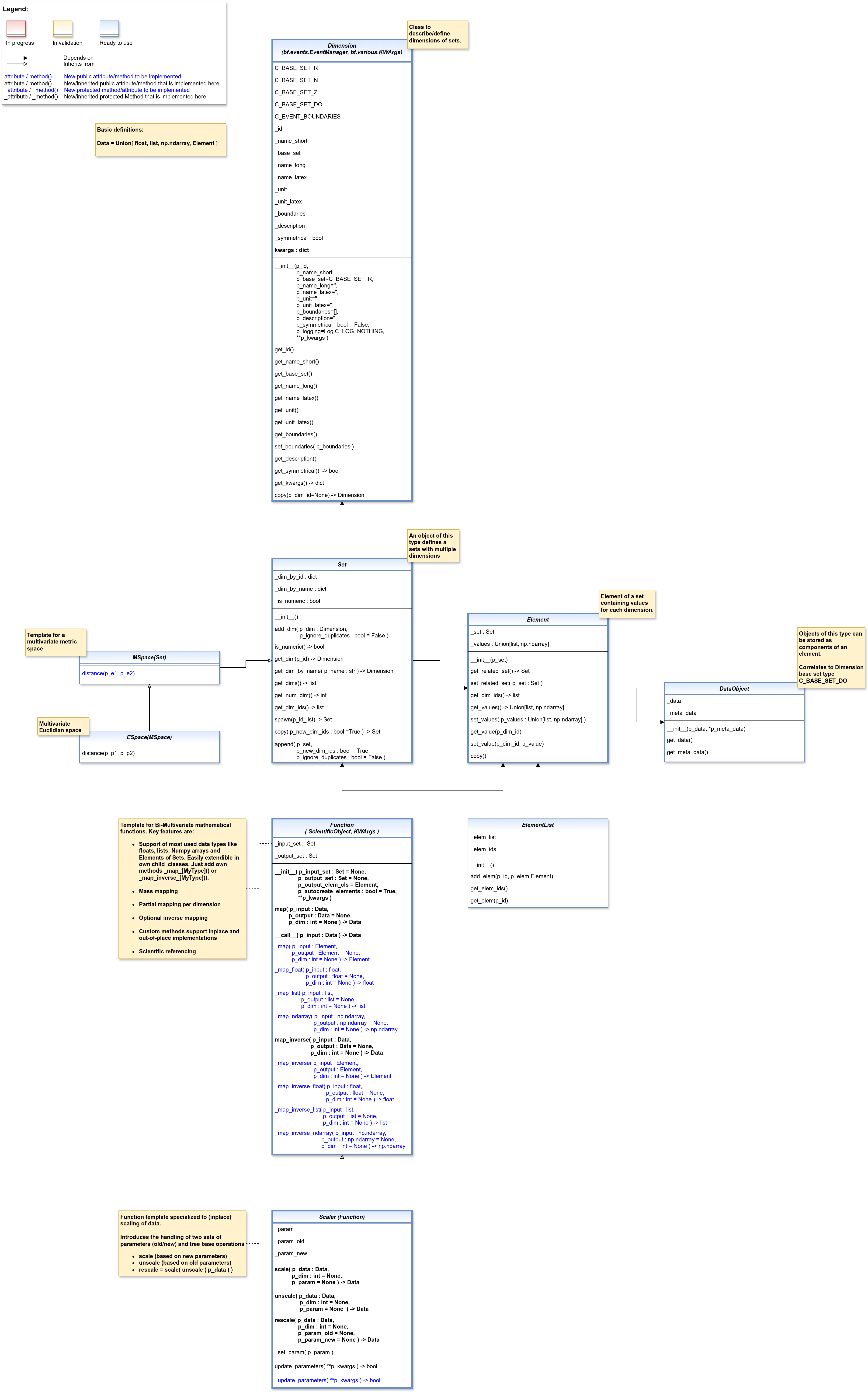
Ver. 3.0.1 (2025-07-11)
This module provides basic mathematical classes.
- class mlpro.bf.math.basics.Dimension(p_name_short, p_base_set='R', p_name_long='', p_name_latex='', p_unit='', p_unit_latex='', p_boundaries: list = [], p_description='', p_symmetrical: bool = False, p_logging=False, **p_kwargs)
Bases:
EventManager,KWArgsObjects of this type specify properties of a dimension of a set.
Parameters:
- p_name_shortstr
Short name of dimension
- p_base_set
Base set of dimension. See constants C_BASE_SET_*. Default = C_BASE_SET_R.
- p_name_long :str
Long name of dimension (optional)
- p_name_latexstr
LaTeX name of dimension (optional)
- p_unitstr
Unit (optional)
- p_unit_latexstr
LaTeX code of unit (optional)
- p_boundarieslist
List with minimum and maximum value (optional)
- p_descriptionstr
Description of dimension (optional)
- p_symmetricalbool
Information about the symmetry of the dimension (optional, default is False)
- p_logging
Log level (see constants of class Log). Default: Log.C_LOG_ALL
- p_kwargsdict
Further optional keyword parameters.
- C_TYPE = 'Dimension'
- C_BASE_SET_R = 'R'
- C_BASE_SET_N = 'N'
- C_BASE_SET_Z = 'Z'
- C_BASE_SET_DO = 'DO'
- C_EVENT_BOUNDARIES = 'BOUNDARIES'
- get_id()
- get_name_short()
- get_base_set()
- get_name_long()
- get_name_latex()
- get_unit()
- get_unit_latex()
- get_boundaries()
- set_boundaries(p_boundaries: list)
Sets new boundaries with respect to the symmmetry and raises event C_EVENT_BOUNDARIES.
- Parameters:
p_boundaries (list) – New boundaries (lower and upper value)
- get_description()
- get_symmetrical() bool
- get_kwargs() dict
Returns all keyword arguments provided during initialization as a dictionary. Alternatively, public attribute kwargs can be used directly.
- copy()
- class mlpro.bf.math.basics.Set
Bases:
objectObjects of this type describe a (multivariate) set in a mathematical sense.
- C_NUMERIC_BASE_SETS = ['N', 'Z', 'R']
- add_dim(p_dim: Dimension, p_ignore_duplicates: bool = False)
Raises the dimensionality of the set by adding a new dimension.
- Parameters:
p_dim (Dimension) – Dimension to be added.
p_ignore_duplicates (bool) – If True, duplicated short names of dimensions are accepted. Default = False.
- is_numeric() bool
Returns True if the set consists of numeric dimensions only.
- get_dims() list
” Returns all dimensions.
- get_num_dim()
Returns the dimensionality of the set (=number of dimensions of the set).
- get_dim_ids()
Returns the unique ids of the related dimensions.
- spawn(p_id_list: list)
Spawns a new class with same type and a subset of dimensions specified by an index list.
- Parameters:
adopted (p_id_list List of indices of dimensions to be)
- Returns:
New object with subset of dimensions
- copy(p_new_dim_ids: bool = True)
- append(p_set, p_new_dim_ids: bool = True, p_ignore_duplicates: bool = False)
- class mlpro.bf.math.basics.DataObject(p_data, *p_meta_data)
Bases:
objectContainer class for (big) data objects of any type with optional additional meta data.
- get_data()
- get_meta_data() tuple
- class mlpro.bf.math.basics.Element(p_set: Set)
Bases:
objectElement of a (multivariate) set.
- Parameters:
p_set (Set) – Underlying set.
- get_dim_ids() list
- get_values() list | ndarray
- set_values(p_values: list | ndarray)
Overwrites the values of all components of the element.
- Parameters:
dimensions. (p_values Something iterable with same length as number of element)
- get_value(p_dim_id)
- set_value(p_dim_id, p_value)
- copy()
- class mlpro.bf.math.basics.ElementList
Bases:
objectList of Element objects.
- add_elem(p_id, p_elem: Element)
Adds an element object under it’s id in the internal element list.
- Parameters:
element (p_id Unique id of the)
added (p_elem Element object to be)
- get_elem_ids() list
- class mlpro.bf.math.basics.MSpace
Bases:
SetObjects of this type represent a metric space. The method distance implements the metric of the space.
- class mlpro.bf.math.basics.ESpace
Bases:
MSpaceObjects of this type represent an Euclidian space. The distance method implements the Euclidian norm.
- class mlpro.bf.math.basics.Function(p_input_set: ~mlpro.bf.math.basics.Set = None, p_output_set: ~mlpro.bf.math.basics.Set = None, p_input_space=None, p_output_space=None, p_output_elem_cls: type = <class 'mlpro.bf.math.basics.Element'>, p_autocreate_elements: bool = True, **p_kwargs)
Bases:
KWArgs,ScientificObjectModel class for an elementary bi-multivariate mathematical function that maps elements of a multivariate input space to elements of a multivariate output space.
- Parameters:
p_input_set (Set = None) – Optional input set, needed for the mapping of objects of type Element.
p_output_set (Set = None) – Optional output set, needed for the mapping of objects of type Element.
p_output_elem_cls (type = Element) – Output element class (compatible to class Element)
p_autocreate_elements (bool = True) – If True, elements of the output space are created automatically during mapping of objects of type Element.
**p_kwargs – Further optional keyword arguments needed for particular custom implementations.
- map(p_input: float | list | ndarray | Element, p_output: float | list | ndarray | Element = None, p_dim: int = None) float | list | ndarray | Element
Maps an input to an output by calling the custom methods _map_[Type]().
- Parameters:
p_input (Data) – Input to be mapped.
p_output (Data = None) – Optional output object as the intended receiver of the mapping result.
p_dim (int = None) – An optional dimension index to which the mapping is restricted.
- Returns:
Result of the mapping.
- Return type:
Data
- _map(p_input: Element, p_output: Element = None, p_dim: int = None) Element
Default custom method for own mappings of single objects of type Element.
- _map_float(p_input: float, p_output: float = None, p_dim: int = None) Element
Custom method for own mappings of single floats.
- Parameters:
p_input (Element) – Input to be mapped.
p_output (Element = None) – Optional output object as the intended receiver of the mapping result.
p_dim (int = None) – An optional dimension index to which the mapping is restricted.
- Returns:
Result of the mapping.
- Return type:
float
- _map_list(p_input: list, p_output: list = None, p_dim: int = None) list
Custom method for own mass mappings of lists.
- Parameters:
p_input (list) – Input to be mapped.
p_output (list = None) – Optional output object as the intended receiver of the mapping result.
p_dim (int = None) – An optional dimension index to which the mapping is restricted.
- Returns:
Result of the mapping.
- Return type:
list
- _map_ndarray(p_input: ndarray, p_output: ndarray = None, p_dim: int = None) ndarray
Custom method for own mass mappings of Numpy arrays.
- Parameters:
p_input (list) – Input to be mapped.
p_output (list = None) – Optional output object as the intended receiver of the mapping result.
p_dim (int = None) – An optional dimension index to which the mapping is restricted.
- Returns:
Result of the mapping.
- Return type:
np.ndarray
- map_inverse(p_input: float | list | ndarray | Element, p_output: float | list | ndarray | Element = None, p_dim: int = None) float | list | ndarray | Element
Inverse mapping of an input to an output by calling the custom methods _map_inverse_[Type]().
- Parameters:
p_input (Data) – Input to be mapped.
p_output (Data = None) – Optional output object as the intended receiver of the mapping result.
p_dim (int = None) – An optional dimension index to which the mapping is restricted.
- Returns:
Result of the mapping.
- Return type:
Data
- _map_inverse(p_input: Element, p_output: Element = None, p_dim: int = None) Element
Default custom method for own inverse mappings of single objects of type Element.
- _map_inverse_float(p_input: float, p_output: float = None, p_dim: int = None) Element
Custom method for own inverse mappings of single floats.
- Parameters:
p_input (Element) – Input to be mapped.
p_output (Element = None) – Optional output object as the intended receiver of the mapping result.
p_dim (int = None) – An optional dimension index to which the mapping is restricted.
- Returns:
Result of the mapping.
- Return type:
float
- _map_inverse_list(p_input: list, p_output: list = None, p_dim: int = None) list
Custom method for own mass inverse mappings of lists.
- Parameters:
p_input (list) – Input to be mapped.
p_output (list = None) – Optional output object as the intended receiver of the mapping result.
p_dim (int = None) – An optional dimension index to which the mapping is restricted.
- Returns:
Result of the mapping.
- Return type:
list
- _map_inverse_ndarray(p_input: ndarray, p_output: ndarray = None, p_dim: int = None) ndarray
Custom method for own mass inverse mappings of Numpy arrays.
- Parameters:
p_input (list) – Input to be mapped.
p_output (list = None) – Optional output object as the intended receiver of the mapping result.
p_dim (int = None) – An optional dimension index to which the mapping is restricted.
- Returns:
Result of the mapping.
- Return type:
np.ndarray
- class mlpro.bf.math.basics.Scaler(p_input_set: ~mlpro.bf.math.basics.Set = None, p_output_set: ~mlpro.bf.math.basics.Set = None, p_input_space=None, p_output_space=None, p_output_elem_cls: type = <class 'mlpro.bf.math.basics.Element'>, p_autocreate_elements: bool = True, **p_kwargs)
Bases:
FunctionTemplate for scaler algorithms scaling, unscaling, rescaling data. This class introduces a parameter handling based on the three attributes _param, _param_old, and _param_new. All custom methods inherited from the class Function shall apply the parameters stored in _param, which is a reference to eigther _param_old or _param_new.
- Parameters:
details. (See class Function for further)
- _param
Internal reference to the active set of function parameters applied to the next scaler action.
- _param_old
Previous parameter set.
- _param_new
Current parameter set.
- scale(p_data: float | list | ndarray | Element, p_dim: int = None, p_param=None) float | list | ndarray | Element
Scales the specified data.
- Parameters:
p_data (Data) – Data to be scaled.
p_dim (int = None) – Optional index of the dimension to be scaled.
None (p_param =) – Optional parameter set to be applied to the scaling operation. If None the set stored in self._param_new is used.
- Returns:
The scaled data.
- Return type:
Data
- unscale(p_data: float | list | ndarray | Element, p_dim: int = None, p_param=None) float | list | ndarray | Element
Unscales the specified data.
- Parameters:
p_data (Data) – Data to be unscaled.
p_dim (int = None) – Optional index of the dimension to be unscaled.
None (p_param =) – Optional parameter set to be applied to the unscaling operation. If None the set stored in self._param_new is used.
- Returns:
The unscaled data.
- Return type:
Data
- rescale(p_data: float | list | ndarray | Element, p_dim: int = None, p_param_old=None, p_param_new=None) float | list | ndarray | Element
Rescales the specified data by unscaling them with previous parameters stored in _param_old and scaling them with the current parameters in _param_new.
- Parameters:
p_data (Data) – Data to be rescaled.
p_dim (int = None) – Optional index of the dimension to be rescaled.
None (p_param_new =) – Optional parameter set to be applied to the unscaling operation. If None the set stored in self._param_old is used.
None – Optional parameter set to be applied to the scaling operation. If None the set stored in self._param_new is used.
- Returns:
The rescaled data.
- Return type:
Data
- _set_parameters(p_param)
Private service method to activate the parameter set suitable for the next scaler operation.
- Parameters:
p_param – Parameter set to be activated.
- update_parameters(**p_kwargs) bool
Method to update the parameters of the scaler. It calls the custom method _update_parameters(), which specifies the actual parameters needed by the particular algorithm.
- Parameters:
p_data (Data) – Data needed to update the parameters of the scaler.
- Returns:
True, if the parameters were changed. False otherwise.
- Return type:
bool
- _update_parameters(**p_kwargs) bool
Custom method to update the parameters of the scaler based on data specific to the particular algorithm. Please set the internal attribute p_param_new with new values and backup the previous content in p_param_old before.
- Parameters:
p_data (Data) – Data needed to update the parameters of the scaler.
- Returns:
True, if the parameters were changed. False otherwise.
- Return type:
bool